
Mental health is an important aspect in the lives of every individual around the world. The presence of a strong and stable support system is essential for those who are dealing with some form of mental illness. This support system includes friends, family and the community at large. Families with members who have a mental illness have a necessity for a support system so as to keep the family unit healthy. There are multiple things communities can do to assist these families.
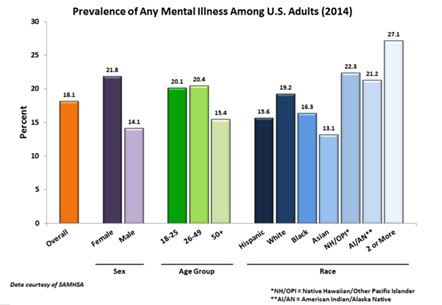
In America today, 20% of youth, from the ages 13 to 18, live with a mental health condition and 50% of all lifetime cases of mental illness begin by the age of 14, with 75% starting at the age of 24.[1] Not to mention, 1 in 5 adults in America experience some kind of mental illness.[2] These statistics tells us that you will know at least one person who is living with a mental health condition. In 2014, nearly 60% of adults with a mental illness did not receive mental health services and nearly 50% of youth aged 8 to 15 also did not receive mental health services.[3] When focusing on gender it was found, in 2014, that women had a greater prevalence rate than men, women with 21.8% whilst men had a rate of 14.1%. These statistics provides us with a glimpse of the current state of mental health in America, that there are many people, even more so with women, who are in need of mental health services and therefore also an established support system. [4]
Communities can do various things to support families that are contending with mental illness. Strengthening the connection to the community enables for pressure to be taken off family members which then creates a space for energy to be used towards living well and for a decrease in the presence of resentment that may occur due to pressure and stress.[5] Community leaders play a pivotal role in creating that support for families. Taking the time to establish programs to increase awareness, educate and providing access to resources are all important within the support system. When these actions are taken, it results in assisting with the long term recovery of people living with mental illness.[6] Leaders also have a positive impact by connecting families to services, as linkages between mental health, substance abuse, disability and other social services are enhanced.
To connect families to services here are a few things that can be done:

- “Learn the basic signs of mental illnesses and other facts about mental health to encourage those in need to seek help.
- Remind others that people can and do recover from mental health challenges and that help is available and effective.
- Train key community members (such as adults who work with the children, youth, older adults, veterans, and LGBT) to identify the signs of depression and suicide and refer people to resources.
- Develop relationships with local mental health service providers and other family and youth organizations to help to direct individuals and families in need to available services and support in the community.”[7]
Having continuous dialogue within the community is paramount. Creating opportunities to build connections between families dealing with mental health challenges through trust and acceptance is fundamental. There are organizations throughout the country where families can meet to have conversations, to openly discuss mental health with other families and community members. To learn more about the community dialogues click here.
Access to resources and the presence of a support system can make a huge deference in the lives of all, to learn more look below:
http://www.mentalhealth.gov/index.html
http://www.nimh.nih.gov/index.shtml
https://www.nami.org/Learn-More/Mental-Health-By-the-Numbers
[1] https://www.nami.org/NAMI/media/NAMI-Media/Infographics/ChildrenMHFacts10-26-15.pdf
[2] https://www.nami.org/NAMI/media/NAMI-Media/Infographics/GeneralMHFacts.pdf
[3] https://www.nami.org/NAMI/media/NAMI-Media/Infographics/GeneralMHFacts.pdf
[4] http://www.nimh.nih.gov/health/statistics/prevalence/any-mental-illness-ami-among-us-adults.shtml
[5] https://www.nami.org/Find-Support/Family-Members-and-Caregivers/Maintaining-a-Healthy-Relationship#sthash.KSc4pXrG.dpuf
[6] http://www.mentalhealth.gov/talk/faith-community-leaders/index.html
[7] http://www.mentalhealth.gov/talk/faith-community-leaders/index.html