
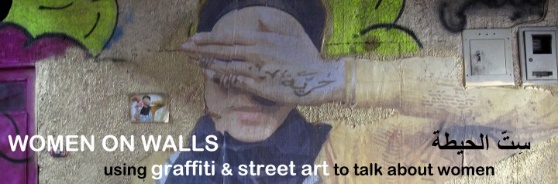
It has been a few months since we covered the use of art to empower women. In this piece we are headed to Middle East and North Africa (MENA) where once again graffiti is being utilized to create a voice. Every year the World Economic Forum publishes a report on the gap between men and women of all countries in the areas of health, education, political empowerment, economics in additional to an overall gender gap assessment. In 2015, it is notable that MENA ranks last in the average global gender gap index.[1] The percentage of closing gender gap within the political empowerment comes to an average of 9% between MENA countries.[2] Even though there has been a vast improvement in areas as education, work needs to be done to cement the presence of women. In the spring of 2013, in Egypt, is where we find the organization Women On Walls (WOW), that has been created to push for the empowerment of Arab women, theirs rights and their visibility in society.
Looking over the River Nile, Mia Grondahl, a Swedish journalist, and Angie Balata, an Egyptian writer, came together to create a project that was to last month but in the end would turn into something more. The project resulted in six successful graffiti workshops and the participation of 20 artists throughout Egypt. With the momentum from the success of the initial WOW project the idea to expand the project across the MENA region came about. Grondahl looked to the artists she had formed relationships throughout her time in Egypt, some were excited and others were hesitant but all were interested in being part of WOW. Balata, co-founder, would go on to leave WOW in August of 2014 as WOW continued on, moving from strength to strength, making its presence felt in Jordan and reaching out to artists in all MENA countries. Now the movement has been cemented with “a network of over 60 street, graffiti and visual artists getting together [for] various WOW projects.”[3]
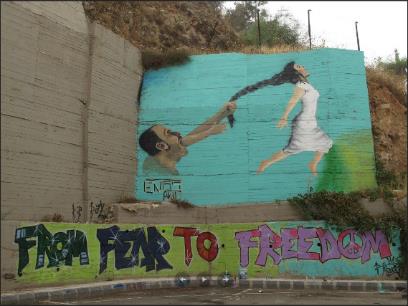
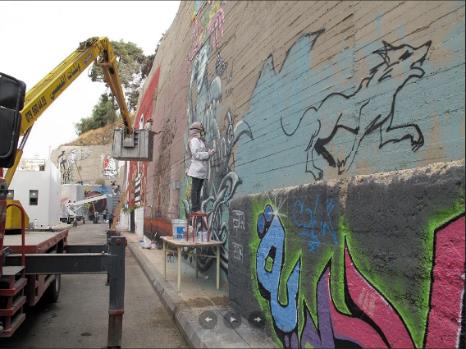
WOW is utilized as a medium to discuss “women’s empowerment, which involves many different issues, including the political, the social, the economic and the cultural.”[4] At the center of WOW and its success in creating a platform for women empowerment is the artists and their own personal stories. In its three years of existence, WOW has participated in multiple as well as held its own art festivals, displaying the work of the artists and continuing to hold workshops for street artists from across the region, participated in panels to speak on the role of women in society and their art work. One example is the first regional street festival established by WOW in Amman, Jordan, in collaboration with the Al Balad Theater of Amman in 2014. WOW and its artists, who hailed from Egypt, Jordan, Qatar, Bahrain, Palestine, Yemen and Syria, worked on the longest wall in Middle East. The theme for this festival was “From Fear to Freedom”. Along with working on the longest wall, there was “local live music and open mic sessions, street art seminars, a showcase of photos & art work related to women’s rights as well as a space for women rights based local initiatives and organizations to promote their work and objectives.”[5]
WOW has transitioned from its initial short project to a movement creating a voice for female graffiti artists and pushing for greater female visibility in North Africa and the Middle East.
To learn more about WOW and the artists involved:
https://www.facebook.com/womenonwalls.WOW/
[1] The Global Gender Gap Report 2015 (World Economic Forum: 2015), 13, http:// http://www3.weforum.org/docs/GGGR2015/cover.pdf.
[2] Ibid.
[3] “About,” Women On Walls, http://womenonwalls.org/about/.
[4] Ibid.
[5] “WOW Baladak Amman,” Women On Walls, http://womenonwalls.org/wow-baladak-amman/.