
Earthquakes, hurricanes, forest fires, and flooding, these are just some of the extreme weathers that countries across the world have endured and continue to endure over the past few months. Although these weather occurrences happen seasonally and are not new, the rate at which they occurred is staggering and this is due to climate change. Climate change, as defined by the United Nations Framework Convention on Climate Change, is the change of climate that is attributed directly or indirectly to human activity that alters the composition of the global atmosphere. In acknowledging the impacts humans have had and taking steps to rectify it, nations across the globe came together in 2016 to sign the Paris Agreement. As climate change affects all people, it is essential to be aware that it has a disproportional impact on the poor and especially poor women.
The gender roles and responsibilities of women in communities around the world lead to women being on the front lines of climate change. “Given existing inequalities and development gaps, climate change ultimately places a great burden on women.”[1] We see this in the execution of daily tasks by women, from the access to
water sources as women are the ones to fetch water for their homes to dealing with various illnesses that their children contract, as noted by Mayor Zandile Gumede of Durban, South Africa, who pointed to how the mother is usually the one who stays home to take care of the sick children, resulting in a reduction of her productivity and career growth.[2] “Inequality limits women’s ability to adapt to the impacts of climate change. This vulnerability is exacerbated by viewing women as victims, rather than key actors who have critical knowledge of their society, economy, and environment, as well as practical skills, which, when recognized and used, can be effective in risk reduction and adaptation.”[3]
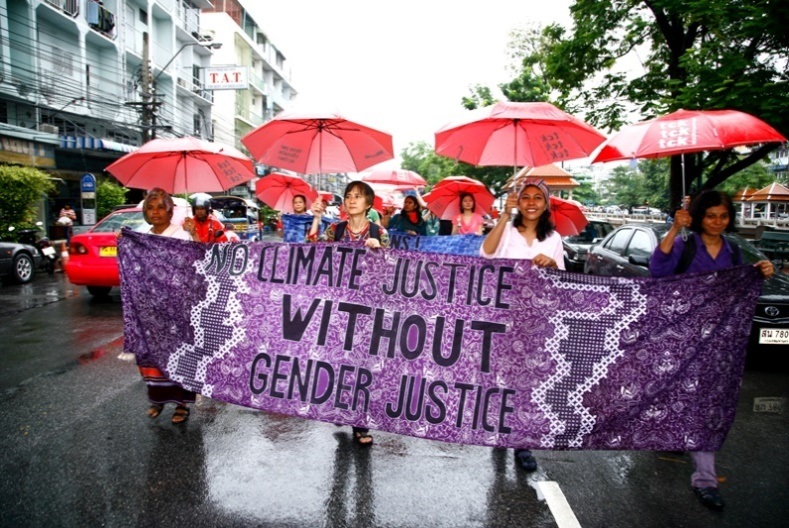
The role and experiences of women in society makes it essential for their voices to be heard in the making of plans and in the creation of procedures to deal with the various impacts of climate change. “Women’s participation at the political level has resulted in greater responsiveness to citizen’s needs, often increasing cooperation across party and ethnic lines and delivering more sustainable peace. At the local level, women’s inclusion at the leadership level has [led] to improved outcomes of climate related projects and policies. On the contrary, if policies or projects are implemented without women’s meaningful participation it can increase existing inequalities and decrease effectiveness.”[4] By including gender analysis in climate change, women will be able to have a greater role on all levels, from grass roots to the state, in assisting with this phenomenon that is having a dire affect on all our lives, especially the vulnerable. We have seen this with Paris Agreement, where women worked at the top level and had an essential role. Mayor Anne Hidalgo of Paris, France, notes, “when men and women mix together with very different experiences, you have a good result. We make things more open than when men work alone.”[5]
[1] ” Women’s Leadership on Gender and Climate Change,” Mary Robinson Foundation Climate Justice, http://www.mrfcj.org/our-work/areas-of-work/womens-leadership-on-gender-and-climate-change/.
[2] Alina Tugend, “Women’s Crucial Role in Combating Climate Change,” New York Times, April 1, 2017, https://www.nytimes.com/2017/04/01/us/womens-crucial-role-in-combating-climate-change.html.
[3] “Why Is Climate Change A Gender Issue?” UN Women, https://www.uncclearn.org/sites/default/files/inventory/unwomen704.pdf.
[4] “Gender and Climate Change,” United Nations Framework Convention of Climate Change, http://unfccc.int/gender_and_climate_change/items/7516.php.
[5] Tugend, “Women’s Role in Climate Change.”