

A few weeks ago, women from across the world competed in the Miss Universe pageant, with Ms. South Africa taking the crown. Beauty pageants continue to be controversial, some view it as empowering women while others see it as exploitative. Beauty pageants have been protested against but have also been used to highlight essential issues in society as awareness of rights of transgender people. In a recent pageant, the contestants themselves became protestors.
In this year’s Miss Peru pageant, the contestant utilized the platform to protest the state of women in Peru, specifically with regards to gender-based violence. Between 2009 and August 2015, more than 700 women have been killed in Peru.[1] It has be found that from the age of 15 to 24, more than one-third of Peruvian women will experience physical violence.[2] And in a study by the United Nations, it was found that more than 50% of women will experience severe domestic violence in her lifetime.[3] The environment of which women live led to thousands of Peruvians demonstrating in Lima and other cities in August 2016, calling for officials and authorities to do more in handling gender-based violence.[4] In the backdrop of this rally and the violence that occurred against women in the months ahead of Miss Peru pageant, the showrunners decided it was important to utilize the platform.
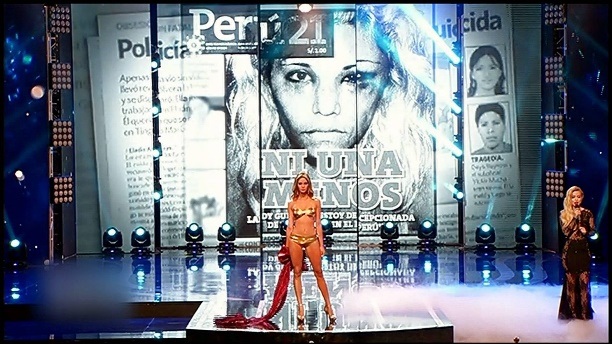
Luciana Olivares, content and strategy manager of Frecuencia Latina, the TV network that broadcasts the competition, stated to National Public Radio (NPR), “We decided that we had the opportunity to turn the pageant around and use it as a platform to mobilize, raise awareness and speak up. We knew the whole country would be watching.”[5] In different segments of the pageant, gender-based violence was highlighted, “during the question-and-answer portion, judges asked the contestants how they would best combat femicide, and the women walked the bathing-suit portion while news items about murdered and assaulted women cycled behind them.”[6] The segment that would go viral across the world would be the moment when each woman went up to the mic to share their measurements, instead shared statistics on gender-based violence against women in their city or in the country.
“My measurements are: 2,202 cases of murdered women reported in the last nine years in my country,” said Camila Canicoba of Lima.
“My measurements are: the 65 percent of university women who are assaulted by their partners,” said Bélgica Guerra of Chincha.
[1] “Peru: Events of 2016,” Human Rights Watch, 2016, https://www.hrw.org/world-report/2017/country-chapters/peru.
[2] Sarah Wildman, “Miss Peru hopefuls chose to highlight women’s safety onstage instead of their measurements,” Vox, October 31, 2017, https://www.vox.com/identities/2017/10/31/16585648/miss-peru-violence-against-women-measurements-statistics-protest.
[3] Ibid.
[4] “Peru: Events of 2016.”
[5] Elda L. Cantú, “Miss Peru Contestants Startle Peruvians By Sharing Stats On Gender Violence,” National Public Radio, November 2, 2017, https://www.npr.org/sections/goatsandsoda/2017/11/02/561414660/miss-peru-contestants-startle-peruvians-by-sharing-stats-on-gender-violence.
[6] Kenzie Bryant, “Miss Perú Contestants Give Gender-Violence Statistics Instead of Their Body Measurements,” Vanity Fair, November 1, 2017, https://www.vanityfair.com/style/2017/11/miss-peru-my-measurements-are-protest-femicide-2017.