
No American can escape the 2016 presidential race news coverage. Amidst the news, conversations about the current election seem to evolve (or, devolve?) into different, more general conversations. Recently, one of the stories involved Margaret Albright and Gloria Steinem, who suggested that supporting Hillary Clinton was the duty of women who considered themselves “feminists.”
Don’t worry; I won’t rehash the politics. To me, the interesting aspect of the controversy was the conversation that ensued about what it meant to be a “feminist.” Female (and many male) supporters of other candidates passionately defended their own feminist stances; they argued that they were, in fact, feminists, despite supporting candidates other than Clinton.
This was interesting to me. Ever since I was a child, I have identified with the term “feminist” with pride. But I often identified with the term with more defiance than pride because of the negative insinuations from both men and women who apply this term. I know many women who strongly object to being called a “feminist.”
By definition, a feminist is a person who supports the advocacy of women’s rights on the grounds of political, social, and economic equality to men. Most women I know are, by definition, feminists. So why is the term considered so undesirable?
There are likely many reasons that “feminist” came to function as an insult. I usually blamed the media. People take their cues from the media starting at childhood, and the media producers, directors, and writers are disproportionately male. My belief was that such negative stereotypes resulted the resistance among men to women who argued against a sexist society. I imagined the stereotypes had arisen unintentionally to a large degree.
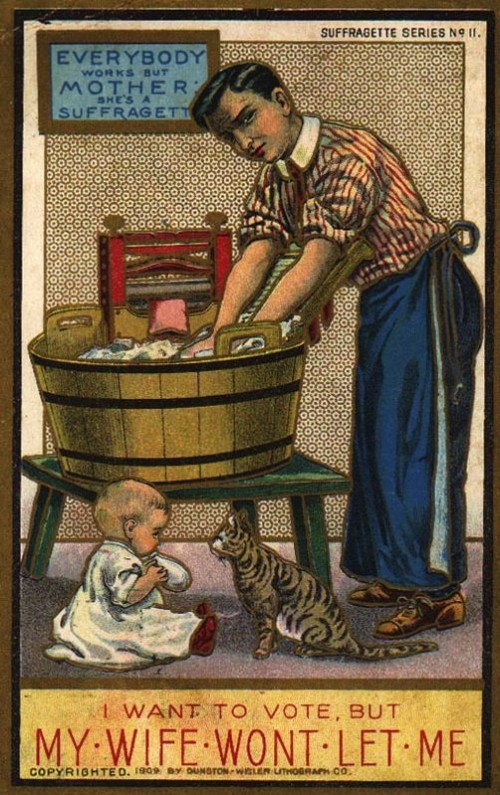 I was wrong. In fact, these stereotypes started as a very intentional propaganda campaign against women suffragists. Prior to the 1920s, when women gained the right to vote, opponents of women suffrage argued that voting rights for women would lead to women neglecting their children and controlling their husbands. (The latter propaganda argument was likely directed more toward husbands, who are portrayed as weak and emasculated in these propaganda posters; see images.) Another branch of the propaganda attempted to portray women suffragists as ugly, aggressive, masculine, demanding, man-hating, uptight, and so forth.
These attacks on people who argued for the rights of women to vote seem absurd to us today. But propaganda is a powerful weapon, and the stereotypes held on long after the 19th amendment was passed in 1920. In a 2013 YouGov poll, 37% of respondents stated that they believed that “feminist” was a negative term.
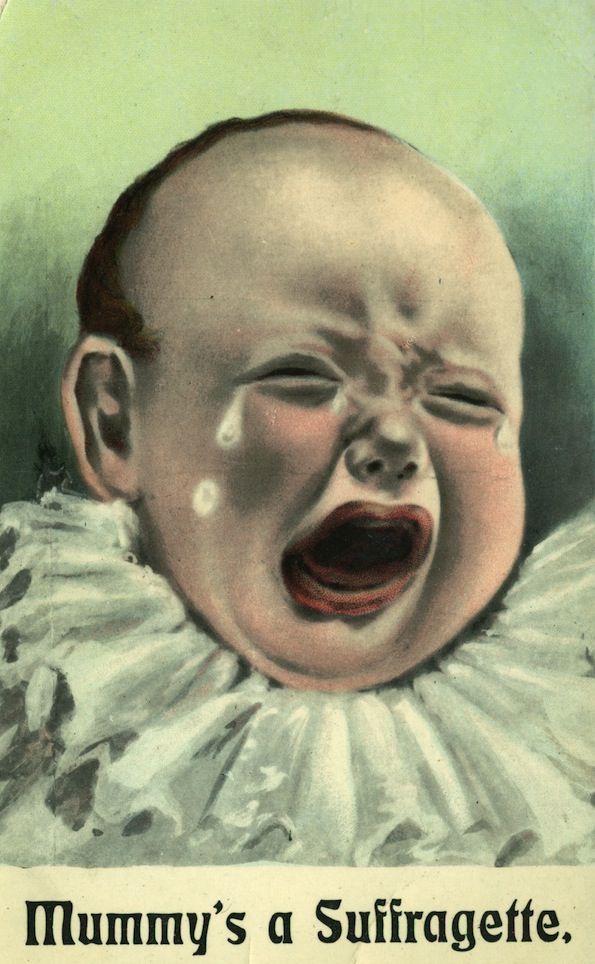 The propaganda that was used pre-1920s was very direct, and therefore, it was much easier to recognize. People were not as bombarded by the media as they are today. There was no TV or internet, and movies were still a rare treat for most. Now, the propaganda is more subtle. Posters don’t (often) exist that say: “Feminists are ugly, mean, controlling!” Instead, from a young age, we are bombarded with characters in movies and television who propagate these stereotypes in subtle ways. Our brains then form unconscious associations between the negative characters and real life individuals.
But rather than trying to guide the media, I believe that the most important (and achievable) goal is to change the conversation. When more women are willing to stand up to society’s underhanded bullying and say “I am a feminist,” then the stereotype is weakened, which makes it easier for more people to identify as feminists, and so forth. But it is not easy. It takes a lot of courage to be one of the first individuals to stand up against the potential social alienation from this cruel and persistent stereotype.
But maybe there is an easier way. Gloria Steinem and Madeleine Albright may not have recruited many Hillary Clinton supporters with their remarks, but the controversy did transform “feminist” into a desirable term for a whole lot of people. How did they do it? For a period of time, the term “feminist” became an exclusive term for an exclusive group of women (Clinton supporters). Suddenly, women were threatened with not being allowed to identify as feminists—and they defended the term! So, maybe I should have saved my logical arguments defending the term “feminist” and instead invested an exclusive Feminist VIP lounge. Sigh… Always in hindsight!
Author’s note: Anti-suffagist propaganda posters are from Palczewski, Catherine H. Postcard Archive. University of Northern Iowa. Cedar Falls, IA.