

In this week’s piece in the Empowering with Art Series, we are heading to Brazil, the largest country in South America. It was not until 2006 when Brazil passed its first criminal law against domestic violence, the Maria da Penha Law on Domestic and Family Violence. This law was named after Maria da Penha, who in 1983 was left paralyzed after being shot by her husband and was then almost electrocuted by him, just two weeks after being released from the hospital.[1] Her case languished in the system for two decades, and it was not until a ruling by the Court of Human Rights where the lack of effort in the prosecution and conviction by Brazil did this law come about. Maria da Penha has gone on to dedicate her life to fighting for women who have gone and are going through what she has. Even though this law created a new environment for women to fight against domestic violence, an average of 15 women a day are killed in Brazil for being women.[2] This year, the government passed a law criminalizing femicide (the gender-motivated killing of women) which in turn has placed more emphasis on the Maria da Penha Law. A major factor in the difficulty of the fight against domestic violence and gender based violence in Brazil, is culture, which is noted by Panmela Castro in an interview with Refinary29.
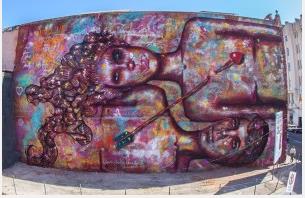
It is culture where Panmela Castro is having an impact as a graffiti artist based in Rio de Janeiro. Castro, a survivor of domestic violence herself, initially used her talent to create awareness on women’s rights and assisted in creating a space for the voices of women and girls to be heard. With the passing of the Maria da Penha Law, “through a network of women graffiti artists, Panmela began to raise awareness about the law in the favelas of Rio, where access to information is often
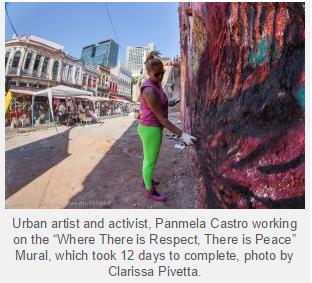 limited.”[3] In 2010, at the age of 27, her work led to the creation of her very own organization, Rede Nami. Bringing women and girls interested in art together and creating a network to speak on gender inequality through public art and graffiti as well as putting on various workshops. She also mentors about 30 girls through Rede Nami and continues to raise awareness of the Maria da Penha Law though the project, Graffiti for the End of Domestic Violence. With this project workshops are held with high school students, graffiti is used as a tool to discuss gender equality, domestic violence, and the Maria de Penha Law among other topics. Castro has been recognized for her work, including receiving an award from the NGO Vital Voices Global Partnership and being named as one of 150 Fearless Women around the world by Newsweek and the Dailybeast.
Information is power, and the ability for women to understand the laws that will help them is important. Panmela Castro uses her talent to create awareness for those who may be left forgotten. In the interview with Refinary29, Castro stated this about graffiti:
“Graffiti is in the streets, and you don’t need to ask for permission to do it. You can just go there and get your message out.”[4]
To learn more about Panmela Castro, her work & Rede Nami (note: websites are in Portuguese):
http://www.panmelacastro.com/#!portflio/c1f5f
http://www.redenami.com/#!graffiti-pelo-fim-da-violncia-/c5qm
[1] UN Women, “Maria da Penha Law: A Name that Changed Society,” August 30 2011, http://www.unwomen.org/en/news/stories/2011/8/maria-da-penha-law-a-name-that-changed-society [2] UN Women, “In Brazil, new law on femicide to offer greater protection,” March 16 2015, http://www.unwomen.org/en/news/stories/2015/3/in-brazil-new-law-on-femicide-to-offer-greater-protection [3] Vital Voices Global Partnership, Featured Voices, http://www.vitalvoices.org/vital-voices-women/featured-voices/panmela-castro [4] Kaelyn Ford, “The Country Where 15 Women Are Killed Each Day, Simply For Being Women,” Octobe 20, 2015, Refinary29, http://www.refinery29.com/2015/10/95689/brazilian-women-feminist-street-art-rio?utm_source=XX%20News#.2gt7km:o7fz